Sika Polyethylene (PE) Waterstop

When the project demands sustained hydrocarbon resistance, Westec PE is often the answer. CE marked under ETA-04/0044 on key profiles, and available in centerbulb, tear web, retrofit, and EB Cap configurations.

Contact Us to Order Call to Order

About PE Polyethylene Waterstop

Sika Westec PE is a Very Low Density Polyethylene (VLDPE) waterstop designed for joint waterproofing in industrial secondary containment structures. Compared to thermoplastic elastomeric rubber waterstop, PE behaves more like a stiff plastic — it has a higher elastic modulus and greater hardness, giving it different performance characteristics in specific chemical environments.

PE is particularly effective for hydrocarbon exposure. ASTM testing has shown that after 1 to 4 weeks of exposure to chemicals such as Benzene, Toluene, and Xylene, followed by drying, PE waterstop returns nearly to its original physical properties. This makes PE a frequent choice for refineries, fuel storage, pipeline applications, and other facilities where sustained hydrocarbon contact is a primary concern. Westec PE profiles 050 and 631 are also the first waterstop profiles to receive European Technical Approval for watersealing bands, approved for CE marking in the European Union under ETA-04/0044.

Typical Applications

Commonly Specified For

  • Refineries and petrochemical manufacturing
  • Ethanol and biodiesel production facilities
  • Fuel storage and tank farms
  • Pipelines and pump stations
  • Pulp and paper mills
  • Land, air, and seaports
  • Pharmaceutical plants
  • Joints with sustained hydrocarbon exposure (Benzene, Toluene, Xylene)

Other Materials May Be Considered When

  • Broader chemical resistance across acids, bases, and solvents is needed — see TPE-R
  • NSF/ANSI 61 certification is required for drinking water contact — see TPE-R
  • Service temperatures exceed 250°F (121°C) — see Stainless Steel
  • The most severe chemical environments are present — see Stainless Steel
  • The application is potable water containment without chemical exposure — see PVC

Material and profile selection should always be verified against project specifications and chemical exposure requirements. Contact us if you’d like assistance reviewing options for your application.

Standard Profiles

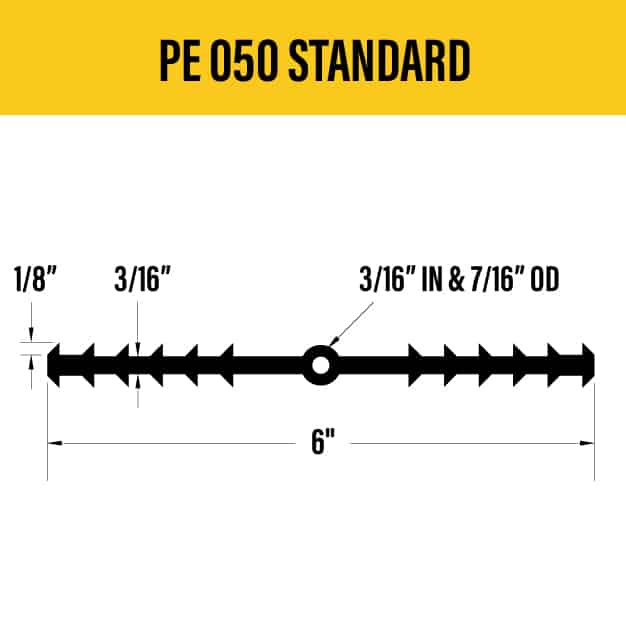
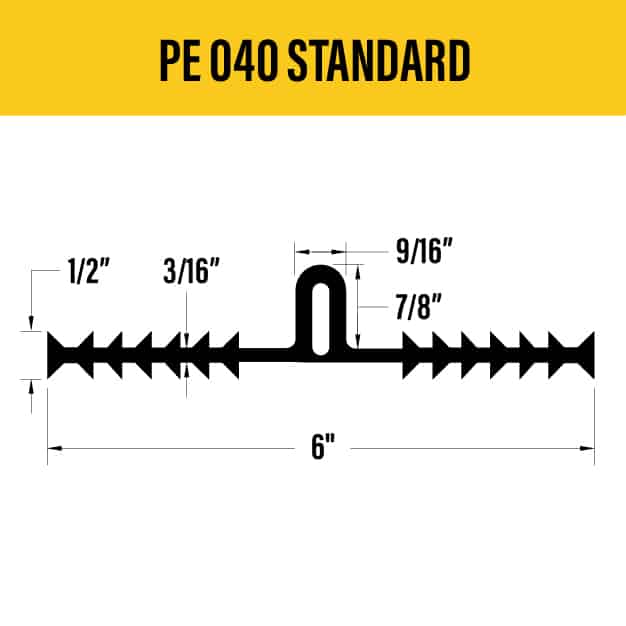
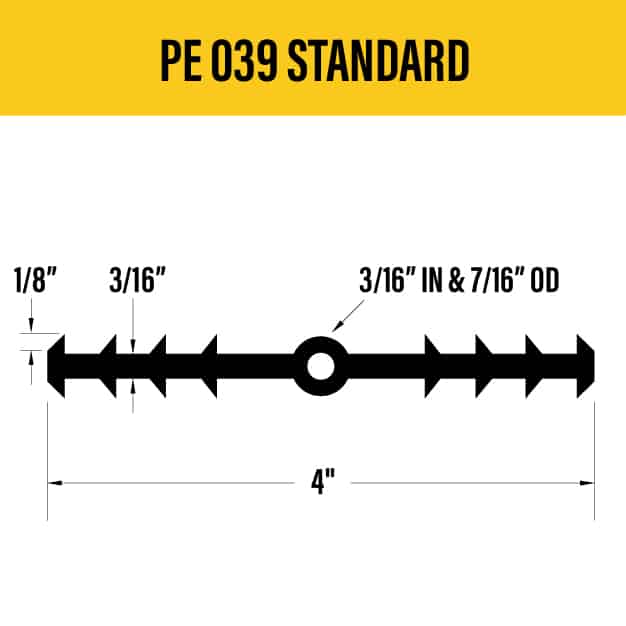
Standard PE profiles are designed for embedded use in new concrete joints. The 039 and 050 are ribbed centerbulb profiles intended for movement joints, where the centerbulb accommodates expansion, contraction, and shear movement. The 040 is a ribbed tear web profile designed for joints expecting larger movements, where the thin tear web in the U-shaped centerbulb is engineered to rupture and allow the bulb to deform without placing the material in tension.

Profile 039 PE ribbed centerbulb cross-section
Profile 039
Width: 4″ (102 mm)
Thickness: 3/16″ (3 mm)
Centerbulb: 3/16″ ID x 7/16″ OD
Style: Ribbed Centerbulb
Profile 050 PE ribbed centerbulb cross-section
Profile 050
Width: 6″ (152 mm)
Thickness: 3/16″ (3 mm)
Centerbulb: 3/16″ ID x 7/16″ OD
Style: Ribbed Centerbulb
Profile 040 PE ribbed tear web cross-section
Profile 040
Width: 6″ (152 mm)
Thickness: 3/16″ (5 mm)
Tear Web: 9/16″ x 7/8″
Style: Ribbed Tear Web

Retrofit Profiles

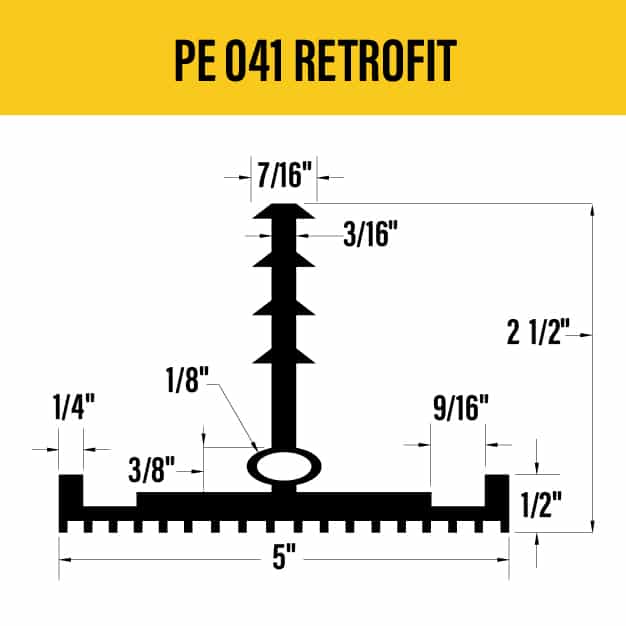
PE retrofit profiles are designed for projects where new concrete meets an existing structure — a common situation in chemical plants and refineries undergoing expansion or modification. Rather than saw-cutting a groove into existing concrete to embed a traditional waterstop, retrofit systems anchor to the existing concrete face using stainless steel batten bars and tapcons, with Westec 151 Novolac Gel Epoxy creating a fluid-tight, chemical-resistant seal between the waterstop and the existing concrete.

Profile 031 PE retrofit cross-section
Profile 031
Base Width: 3 1/4″ (82 mm)
Height: 2 1/2″ (63 mm)
Thickness: 3/16″ (5 mm)
Material: PE (VLDPE)
Profile 041 PE retrofit cross-section
Profile 041
Base Width: 5″ (127 mm)
Height: 2 1/2″ (64 mm)
Thickness: 3/16″ (5 mm)
Material: PE (VLDPE)

All retrofit systems include stainless steel batten bars and tapcons. Westec 151 Novolac Gel Epoxy is used to create the seal between the waterstop and existing concrete.

EB Cap Profiles

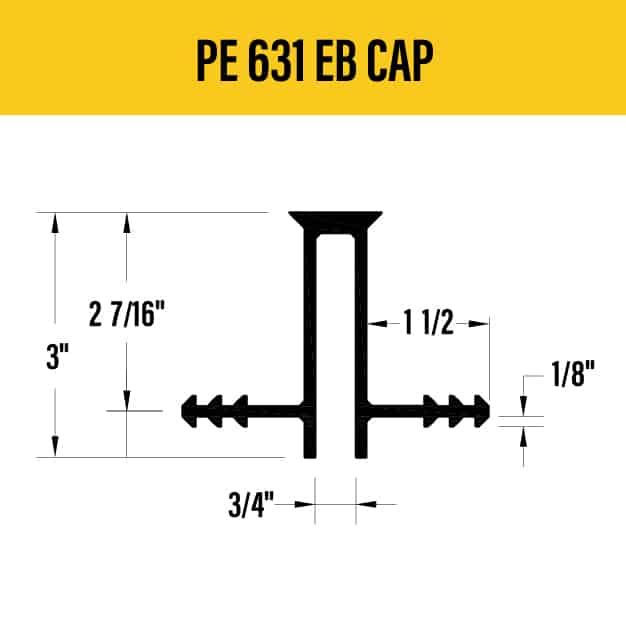
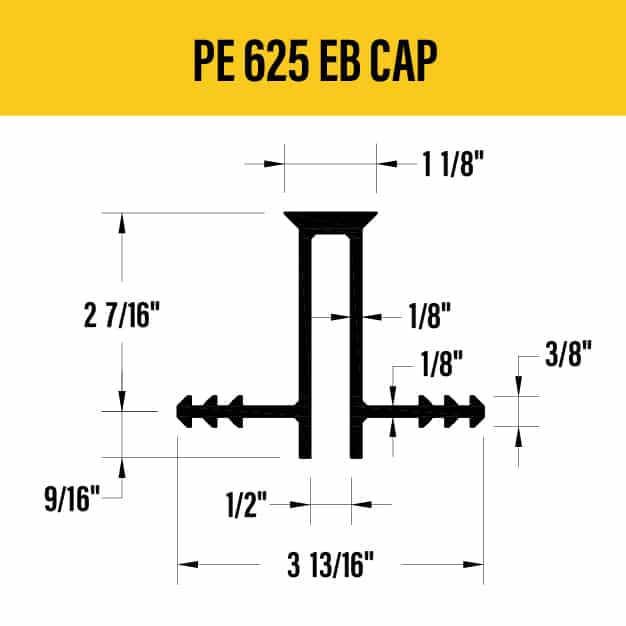
The patented Westec Expansion Board Cap Seal system (US Patent #5,378,386) integrates the waterstop, forming system, expansion board, joint seal, and load transfer units into a single structure. The system is designed for one-step placement, eliminating the need for stripping forms, saw-cutting, or poured-in-place sealants. PE profile 631 is among the first profiles to receive European Technical Approval and is approved for CE marking under ETA-04/0044.

Profile 625 PE EB Cap cross-section
Profile 625
Base Width: 3 13/16″
Cap Width: 1 1/8″
Height: 2 7/16″
Material: PE (VLDPE)
Profile 631 PE EB Cap cross-section
Profile 631
Base Width: 3/4″ (19 mm)
Cap Width: 1 1/2″ (38 mm)
Height: 3″ (76 mm)
Material: PE (VLDPE)

EB Cap Retrofit Profiles

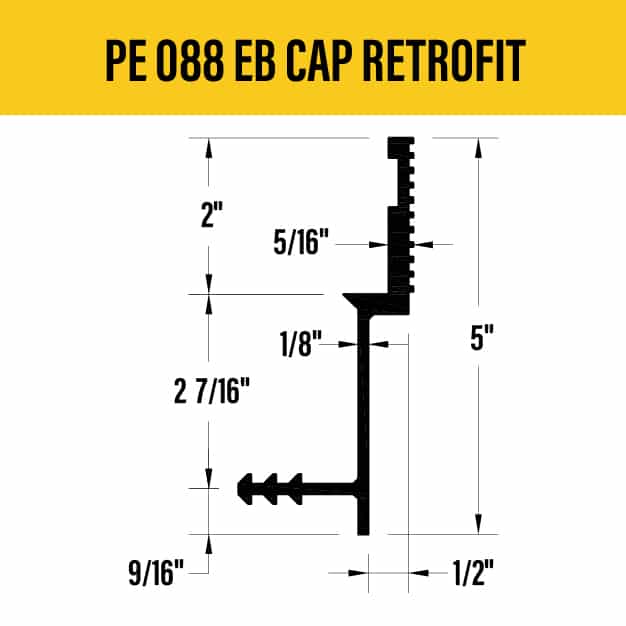
EB Cap Retrofit profiles combine the integrated joint design of the patented EB Cap system with retrofit anchoring for use against existing concrete. These profiles are appropriate when the EB Cap approach is desired for a tie-in or expansion against a previously poured structure. Like other retrofit systems, EB Cap Retrofit installation uses stainless steel batten bars, tapcons, and Westec 151 Novolac Gel Epoxy.

Profile 087 PE EB Cap Retrofit cross-section
Profile 087
Height: 62 mm (2-7/16″)
Base Width: 76 mm (3″)
Cap Width: 51 mm (2″)
Material: PE (VLDPE)
Profile 088 PE EB Cap Retrofit cross-section
Profile 088
Height: 5″
Base Width: 2 7/16″
Cap Width: 2″
Material: PE (VLDPE)

Physical Properties & Compliance

Sika Westec PE is a Very Low Density Polyethylene (VLDPE) waterstop, tested to meet the following industry-standard requirements:

Tensile Strength
2,000 psi (ASTM D638)
Elongation
800% (ASTM D638)
Tensile Modulus
4,200 psi (ASTM D638)
Hardness
40 Shore D (ASTM D2240)
Composition
VLDPE Polyethylene
Hydrocarbon Recovery
Near-original after drying
EU Certification
CE marked (050 & 631)
Chemical Resistance
Per ASTM D-471

Installation Overview

Westec PE waterstop must be installed prior to concrete placement to ensure proper positioning and consolidation around the profile. All transitions, intersections, and splices should be heat welded to maintain continuity. Sika Greenstreak PVC welding equipment can be used for PE, with the temperature set higher at approximately 410°F (210°C). Factory-fabricated intersections are widely recommended for all changes of direction. Always refer to the manufacturer’s installation guide and project specifications for complete instructions.

1

Position

Center the waterstop over the joint, with roughly half the profile projecting into each pour.

2

Secure

Wire the outer flange to reinforcement using brass grommets (pre-punched on 6″ and 9″ profiles) or similar methods.

3

Splice

Heat-weld field splices at 410°F using a Sika Greenstreak splicing iron. Factory fabrications are recommended at intersections.

4

Pour

Place and consolidate concrete around both flanges to fully encapsulate the waterstop.
Frequently Asked Questions

+When should I specify PE over TPE-R waterstop?
PE is particularly effective for sustained hydrocarbon exposure — Benzene, Toluene, and Xylene — where ASTM testing has shown that the material returns nearly to its original properties after 1 to 4 weeks of exposure and subsequent drying. TPE-R offers broader resistance across a wider variety of chemicals including acids, bases, and many solvents, along with greater flexibility (450% elongation vs. PE’s higher modulus). For dedicated hydrocarbon applications, PE is often the better match. For mixed chemical exposure, TPE-R is more commonly specified. Material selection should always be verified against the project’s chemical resistance chart and engineering requirements.
+What does the CE marking on profiles 050 and 631 mean?
Profiles 050 and 631 are among the first waterstop profiles to receive European Technical Approval for watersealing bands under ETA-04/0044, allowing them to be CE marked for use in the European Union. The certification provides standardized performance verification recognized across EU member states. For projects with European or international specifications referencing CE-marked materials, these two profiles may be the appropriate choice within the Westec line.
+How does PE behave differently from TPE-R during installation?
PE is stiffer than TPE-R, with a higher elastic modulus (4,200 psi vs. 1,000 psi) and harder feel (40 Shore D vs. 85 Shore A). In practice, this means PE behaves more like a rigid plastic during handling, while TPE-R has more rubber-like flexibility. Both materials use the same Sika Greenstreak welding equipment at the same elevated temperature (approximately 410°F / 210°C). PE’s 800% elongation rating is actually higher than TPE-R’s 450%, though its higher initial stiffness changes how it deforms under joint movement.
+What’s the difference between profile 039 and profile 050?
Both are 3/16″ thick PE ribbed centerbulb profiles with matching centerbulb geometry (3/16″ ID x 7/16″ OD). The primary difference is width: 039 is 4″ wide while 050 is 6″ wide, providing greater concrete coverage on each flange. The 050 also carries CE marking under ETA-04/0044 for use in the European Union, while 039 does not. Project-specific requirements should drive the final selection.
+Can I field-splice PE waterstop using my existing PVC welding equipment?
Yes. Sika Greenstreak PVC welding equipment and techniques can be used for PE, with the temperature set higher at approximately 410°F (210°C) versus the lower temperature used for standard PVC. Factory-fabricated intersections are still recommended for all L’s, T’s, crosses, and other changes of direction, since field-fabricated intersections are widely cited as a leading cause of waterstop performance issues.
+What epoxy is required for PE retrofit installations?
All Westec retrofit systems use Westec 151 Novolac Gel Epoxy to create a fluid-tight, chemical-resistant seal between the waterstop and existing concrete. This is different from the 7300 structural epoxy typically used with the Greenstreak PVC retrofit line — 151 Novolac is formulated specifically for chemical exposure environments. Retrofit hardware also includes stainless steel batten bars and tapcons.
+Is PE waterstop suitable for drinking water structures?
PE waterstop does not carry NSF/ANSI 61 certification within the Westec line. For drinking water containment structures where this certification is required, TPE-R (Envirostop) is the appropriate choice among the chemically resistant waterstop options. PE is typically specified for industrial chemical containment rather than potable water applications.