About Stainless Steel Waterstop
Sika Westec Stainless Steel Waterstop is fabricated from 316 low carbon stainless steel, engineered for the most demanding industrial joint waterproofing applications. Where flexible thermoplastic waterstops reach their service limits — whether due to extreme temperatures or aggressive chemical exposure — stainless steel offers a metallic seal capable of withstanding conditions that would compromise PVC, TPE-R, or PE materials.
Stainless steel waterstop is most commonly specified for high-temperature environments exceeding 250°F (121°C), or for the most severe chemical applications where thermoplastic waterstops are not rated for the exposure. Profiles are provided in 10-foot lengths, with installation completed by TIG welding at all transitions, intersections, and splices. It’s worth noting that many applications historically served by stainless steel waterstop can now be handled by Westec TPE-R, including ozone contact structures — so material selection often comes down to the specific temperature and chemical profile of the project.
Typical Applications
✓Commonly Specified For
- High-temperature environments exceeding 250°F (121°C)
- The most severe chemical exposure conditions
- Petrochemical and refinery applications at elevated temperatures
- Industrial process containment with aggressive media
- Projects requiring metallic joint integrity
- Applications where thermoplastic waterstops are not rated
- Long-term durability in extreme service conditions
→Other Materials May Be Considered When
- Service temperatures stay below 250°F and broad chemical resistance is sufficient — see TPE-R
- The application is an ozone contact structure — see TPE-R
- Sustained hydrocarbon exposure is the primary concern — see PE
- NSF/ANSI 61 certification is required for drinking water — see TPE-R
- The application is potable water containment without chemical exposure — see PVC
- Joint flexibility is a primary requirement — see TPE-R or PVC
Material and profile selection should always be verified against project specifications, temperature requirements, and chemical exposure conditions. Contact us if you’d like assistance reviewing options for your application.
Standard Profiles
Standard stainless steel profiles are designed for embedded use in new concrete joints. Each profile is formed from 316 low carbon stainless steel sheet, with the geometry creating both mechanical interlock with the surrounding concrete and the watertight seal across the joint. Standard profiles vary primarily in width and rib geometry, with selection generally driven by joint width, expected hydrostatic conditions, and project specification.
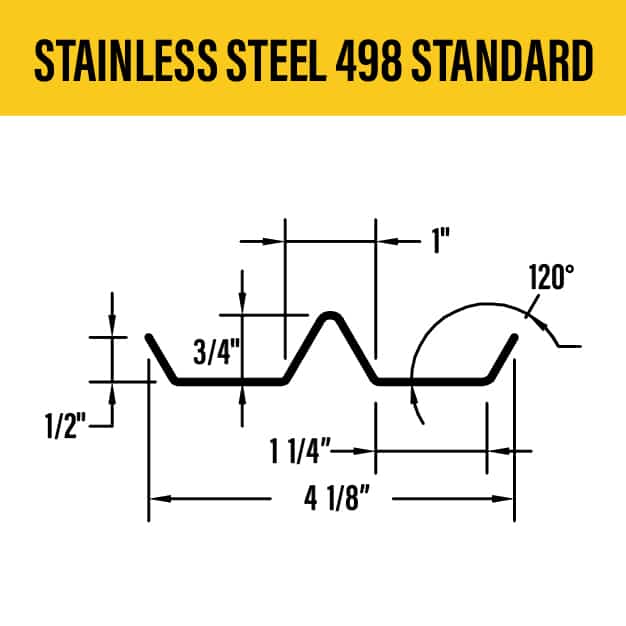
Profile 498
Width: 4 1/8″
Rib Height: 1″
Length: 10 ft
Material: 316 Stainless Steel
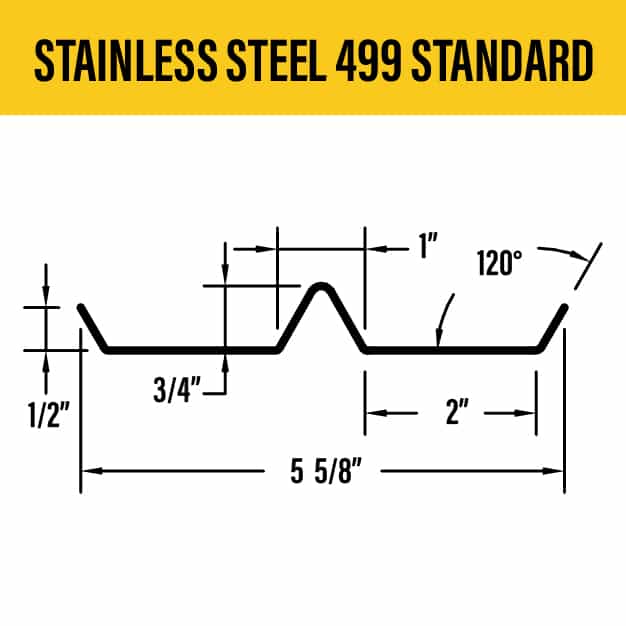
Profile 499
Width: 5 5/8″
Rib Height: 1″
Length: 10 ft
Material: 316 Stainless Steel
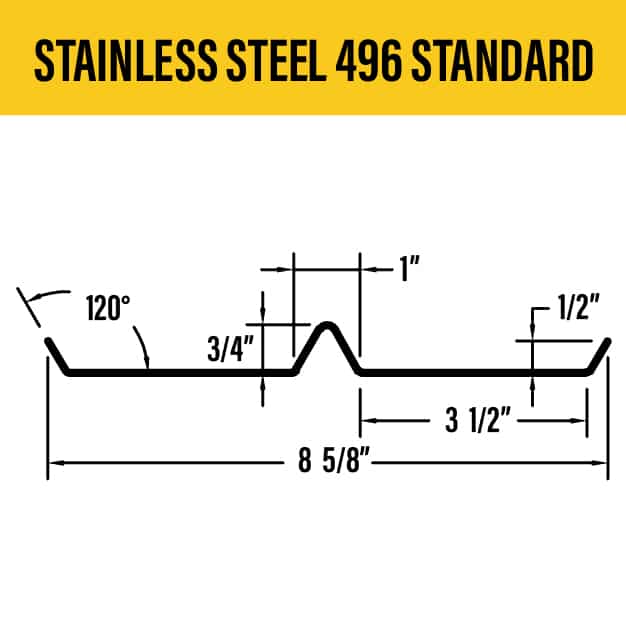
Profile 496
Width: 8 5/8″
Rib Height: 3 1/2″
Length: 10 ft
Material: 316 Stainless Steel
Retrofit Profiles
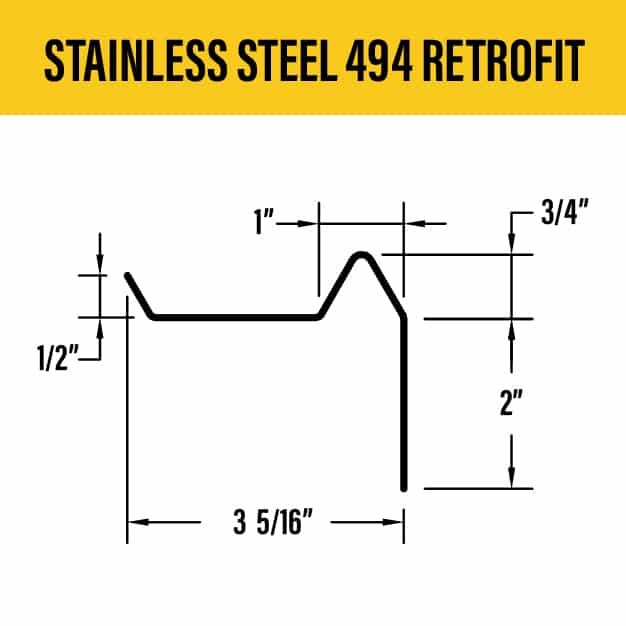
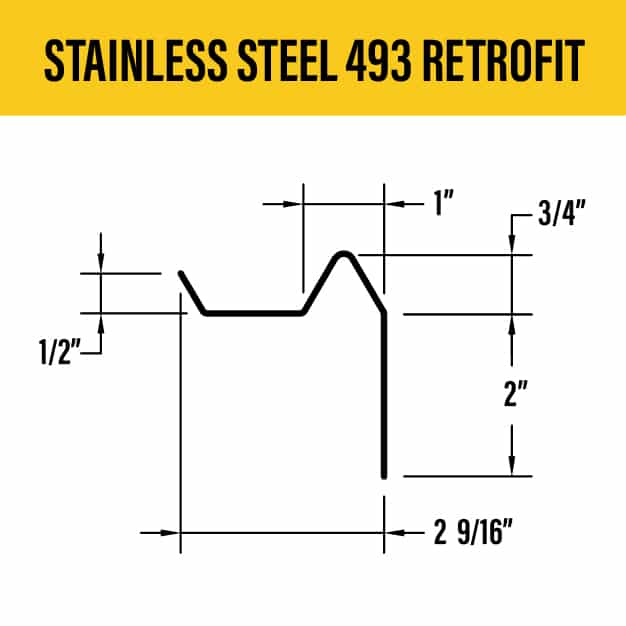
Stainless steel retrofit profiles are designed for projects where new concrete meets an existing structure — a common situation in industrial expansions, retrofits, or tie-ins to legacy infrastructure. Rather than saw-cutting a groove into existing concrete, retrofit profiles anchor to the existing concrete face using stainless steel batten bars and tapcons, with Westec 151 Novolac Gel Epoxy creating a chemical-resistant seal between the waterstop and the existing concrete.
Profile 493
Base Width: 2 9/16″
Height: 2″
Length: 10 ft
Material: 316 Stainless Steel
Profile 494
Base Width: 3 5/16″
Height: 2″
Length: 10 ft
Material: 316 Stainless Steel
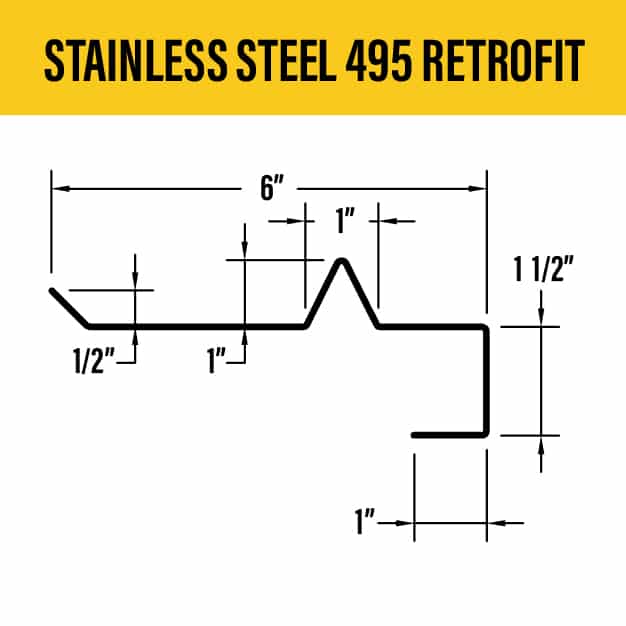
Profile 495
Base Width: 6″
Height: 1 1/2″
Length: 10 ft
Material: 316 Stainless Steel
All retrofit systems include stainless steel batten bars and tapcons. Westec 151 Novolac Gel Epoxy is used to create the seal between the waterstop and existing concrete.
Physical Properties & Compliance
Sika Westec Stainless Steel Waterstop is fabricated from 316 low carbon stainless steel, tested per ASTM A370 and meeting the requirements of ASTM A240 Table 2:
Tensile Strength
75,000 psi (ASTM A370)
Yield Strength
25,000 psi (ASTM A370)
Elongation
40% in 2″ min. (ASTM A370)
Hardness
95 max. Rockwell B
Material Grade
316 Low Carbon Stainless
Service Temperature
> 250°F (121°C)
Standard Length
10 ft per piece
Chemical Resistance
Severe environment rated
Installation Overview
Westec Stainless Steel Waterstop must be installed prior to concrete placement to ensure proper positioning and consolidation around the profile. Unlike thermoplastic waterstops, all transitions, intersections, and splices on stainless steel profiles must be TIG welded by a qualified welder to maintain continuity. Factory-fabricated intersections are widely recommended for all changes of direction, as field welding requires specialized equipment and skilled labor. Always refer to the manufacturer’s installation guide and project specifications for complete instructions.
Center the waterstop over the joint, with roughly half the profile projecting into each pour.
Anchor the waterstop in place using tie wire or similar methods compatible with the rigid profile.
All transitions, intersections, and splices must be TIG welded by a qualified welder. Factory fabrications are recommended.
Place and consolidate concrete around the profile to ensure full encapsulation and mechanical interlock.
Frequently Asked Questions
+When is stainless steel waterstop the right choice over thermoplastic options?
Stainless steel is generally specified in two scenarios: high-temperature service environments exceeding 250°F (121°C), where thermoplastic waterstops are not rated, and the most severe chemical exposure conditions, where TPE-R or PE materials are no longer sufficient. For applications below 250°F with standard industrial chemical exposure, TPE-R or PE may offer comparable performance at lower material and installation costs. It’s also worth noting that many applications historically served by stainless steel — including ozone contact structures — can now be handled by Westec TPE-R.
+Why 316 low carbon stainless steel specifically?
316 stainless steel is selected for its superior corrosion resistance compared to 304 grade, particularly in chloride-containing and chemically aggressive environments. The “low carbon” designation (sometimes called 316L) reduces carbide precipitation during welding, helping to maintain corrosion resistance at the heat-affected zones around field welds and factory fabrications. This makes 316 low carbon the appropriate choice for waterstop applications where TIG welding is part of the installation.
+What’s the difference between heat welding and TIG welding for waterstops?
Heat welding is the standard method for thermoplastic waterstops like PVC, TPE-R, and PE — it melts and fuses the material using a specialized splicing iron. TIG (Tungsten Inert Gas) welding is the appropriate method for stainless steel, requiring a qualified welder with TIG equipment and shielding gas. The two methods are not interchangeable, and the equipment and skill requirements are different. Because of this, factory-fabricated intersections and changes of direction are particularly valuable for stainless steel projects, as they reduce the amount of skilled field welding required.
+Can stainless steel waterstop accommodate joint movement?
Stainless steel waterstops are far less flexible than thermoplastic alternatives — the 40% elongation rating in 2″ is substantially lower than TPE-R (450%) or PE (800%). As a result, stainless steel is generally better suited to construction joints or non-moving joints rather than expansion joints with significant anticipated movement. For applications where both extreme service conditions and joint movement are factors, the design should be reviewed by a project engineer to determine whether stainless steel is appropriate or whether a different solution may be needed.
+How are stainless steel waterstops packaged and shipped?
Westec stainless steel waterstops are supplied in 10-foot lengths across all standard and retrofit profiles. Unlike rolled thermoplastic waterstops, stainless steel profiles maintain their formed shape during shipping and handling and don’t require unrolling or relaxation time before installation. Factory-fabricated intersections, transitions, and custom changes of direction can be ordered separately and shipped alongside straight lengths.
+What epoxy is required for stainless steel retrofit installations?
All Westec retrofit systems — including stainless steel retrofit profiles — use Westec 151 Novolac Gel Epoxy to create a chemical-resistant seal between the waterstop and existing concrete. Retrofit hardware also includes stainless steel batten bars and tapcons, which are compatible with the metallic profile and maintain corrosion resistance at the anchor points.
+How do I determine whether my project needs stainless steel or TPE-R?
The decision generally comes down to two questions: what is the maximum service temperature, and what is the specific chemical exposure? If service temperature exceeds 250°F (121°C), stainless steel is typically the appropriate choice. If temperature is within thermoplastic limits but the chemical exposure is exceptionally aggressive or outside the published ratings of TPE-R and PE, stainless steel may still be specified. For most other industrial applications, TPE-R covers a broad enough range of conditions to be considered first. Material selection should always be verified against the Westec Chemical Resistance Chart and the project specification.